


-
414 Block B, ZT Times Plaza, Wuhan, Hubei, China

Blog
GPS And Anti-Theft Systems In EZBKE Motorcycles
When you line up EZBKE’s related pages around Electric Motorcycle, GPS tracking and anti-theft, 4G/GPS IoT Module: The Backbone Of Fleet Operations, and Security Features For Shared Scooter Fleets, one thing shows up pretty quick: this brand does not treat security like a cheap add-on. It treats it like part of the whole stack—vehicle, controller, cloud, and fleet ops. That matters, because buyers don’t really ask for “advanced telematics architecture.” They ask a much simpler question: If I park this thing outside, am I safe or am I done? EZBKE’s answer, across those pages, is pretty clear. A tracker alone is not enough. You need location, lock logic, tamper response, recovery workflow, and stable connectivity working together.
GPS tracking and anti-theft
The first real argument is simple: GPS tracking helps sales because theft fear kills deals. EZBKE’s own writing says anti-theft lowers buyer friction and gives people “worry-free parking and theft recovery support.” Bosch’s official ConnectModule page says the same thing in more product language: movement alerts, automatic GPS tracking, live location, and theft report creation all reduce anxiety before and after the sale. In plain English, security is not just a post-sale feature. It helps close the order. Thats especially true for city commuters, family riders, delivery users, and higher-value electric motorcycle buyers who park outside offices, shops, or apartment blocks.
A lot of sellers still pitch speed first and protection second. That’s backwards for many urban scenes. In real street use, the rider worries less about hitting top speed for five seconds and more about whether the bike is still there after lunch. So when you write about EZBKE motorcycles, the sharp angle is not “this model has GPS.” The sharper angle is: this security layer protects the asset, reduces parking stress, and supports recovery if the bike gets moved. That is a stronger value story, and honestly, it sounds more real.
Bucket 4: Theft, tracking, and control (the highest perceived value)
EZBKE’s Urban M content says this part out loud: for electric motorcycles, the highest perceived value bundle is GPS tracker + immobilizer, then alarm + disc lock / chain lock, then secure storage. That tells you something important. Buyers don’t see theft protection as decoration. They see it as part of basic ownership sanity. For dealers, wholesalers, and OEM/ODM buyers, this is where margin and trust often meet. Not sexy, but it closes.
4G/GPS IoT Module: The Backbone Of Fleet Operations
EZBKE’s 4G/GPS article makes the second major point: GPS becomes far more useful when it sits inside a live IoT pipeline. The page says operators need to see the vehicle, control it, and protect it in real time. That means real-time location, remote unlock and lock, and anti-theft response are all part of one operating layer, not three random gadgets zip-tied together. For B2B buyers, this matters a lot. A bike or scooter platform that can’t talk cleanly to the backend becomes a service headache fast. You get slow unlocks, ghost positions, more manual checks, and extra after-sales drag.
There’s another smart point on that page too. EZBKE talks about multi-constellation GPS—GPS, GLONASS, BeiDou, and Galileo—to improve accuracy in dense urban zones. That’s not spec-sheet fluff. In city canyons, weak positioning creates fake parking spots, messy geo-fence records, and wasted retrieval time. So the argument is not just “more satellites sounds advanced.” The real argument is: better location accuracy means fewer ops mistakes, cleaner dispatch, and more believable app data for the rider. You want the vehicle to show up where it actually is, not where the map kinda guesses it might be.
Security Features For Shared Scooter Fleets
The strongest EZBKE article for building this topic is probably Security Features For Shared Scooter Fleets, because it stops talking like a catalog and starts talking like an operator. The clearest point in that article is this: put the lock in the motor and firmware, not just on the handlebar. EZBKE describes remote lock or immobilize through a controller kill path and motor hold torque. That means the vehicle is not relying only on visible hardware. Even if somebody tries a lift-and-go or hot-wire move, the system can shift from simple alerting into real immobilization. That’s a much better anti-theft posture than a cheap external tracker alone.
The page gets even better when it talks about tamper/openshell & battery pull detect and private APN/VPN, certs. This is the stuff many buyers never hear, but serious fleet people do care. Tamper sensing helps when theft is really about stripping parts or pulling the battery for resale. Secure IoT matters because if the command path itself is weak, then remote lock, alerts, and telemetry can be spoofed or blocked. So the deeper argument is this: a good anti-theft system is not only about finding a stolen bike; it is also about making the bike harder to misuse, harder to resell, and harder to attack digitally. That’s proper fleet-grade thinking.
Data Table: Key Arguments & Sources
| Related page / keyword | Concrete point | Why it supports the article |
|---|---|---|
| GPS tracking and anti-theft | Theft fear is a deal killer, and visible anti-theft features lower buyer friction before purchase. | Good for city buyers, family riders, premium commuters, and any B2B buyer who sells on trust. |
| 4G/GPS IoT Module: The Backbone Of Fleet Operations | Real-time location, remote unlock/lock, and anti-theft recovery work best as one connected system. | Shows that GPS is part of ops control, not just a map pin. |
| Multi-Constellation GPS: Accuracy In The Urban Jungle | GPS + GLONASS + BeiDou + Galileo improve location accuracy in dense city environments. | Better geo-fence behavior, fewer ghost positions, cleaner dispatch. |
| Security Features For Shared Scooter Fleets | Remote lock/immobilize uses controller logic, while tamper and battery-pull detection cut resale and parts theft. | Strong proof that anti-theft is a system stack, not a single accessory. |
| Bucket 4: Theft, tracking, and control (the highest perceived value) | EZBKE explicitly lists GPS tracker + immobilizer, alarm, and locks as high-value accessories. | Confirms strong buyer demand and upsell relevance. |
| ConnectModule: more than just GPS – theft protection for your eBike | Alerts, live tracking, theft reports, and disabled motor support make stolen vehicles less attractive. | Useful outside the scooter scene too; supports the broader light EV security logic. |
Electric Motorcycle
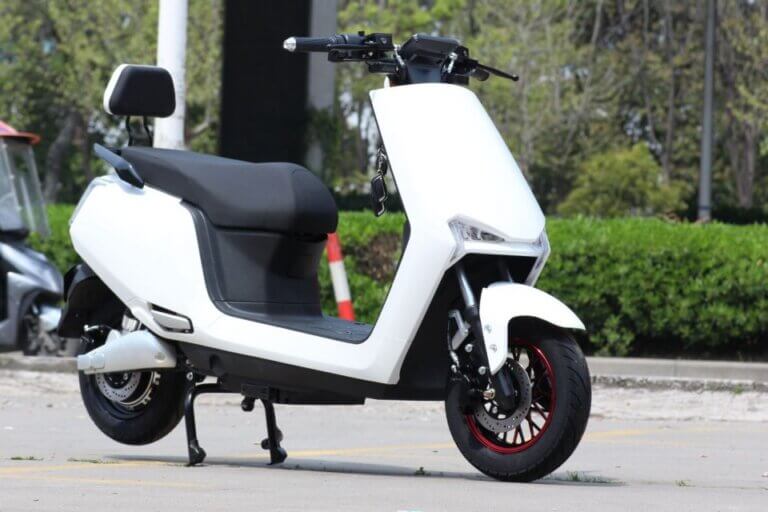
Now bring that logic back to EZBKE’s own Electric Motorcycle category. The category page positions the line as industrial-grade, OEM/ODM-ready, with waterproof frames, UL-certified batteries, and range up to 200 km. That’s important because security doesn’t live in a vacuum. Buyers who source in bulk usually want the whole package: compliant battery story, reliable platform, customization room, and a protection layer that matches real city use. This is where Urban M fits naturally. Urban M should not sell anti-theft like a side accessory. It should sell it as part of the platform promise: less downtime, lower loss exposure, easier fleet control, and a cleaner story for distributors.
S4 best adult commuter electric moped scooter wholesaler oem
The S4 is a good example of why this matters in daily operations. EZBKE positions it for customization or bulk orders, daily deliveries or commutes, with a Bosch motor, portable lithium battery, 75–150 km range, dual disc brakes, and wet-road-friendly tires. Put that into a real use case and the argument gets practical fast: a commuter or delivery fleet with that kind of route coverage needs more than battery range. It needs parking confidence, recovery support, and quick lock control when the unit is off-route or left in a risky area. Otherwise, the good range just means the vehicle can disappear farther.
X1 moped electric scooter with seat for adults factory oem
The X1 pushes the same story from a more urban, compact angle. EZBKE describes it as a city-focused electric motorcycle with a 2,000W Bosch motor, removable Samsung-cell battery, 75–90 km range, 150 kg max load, and EEC approval. That kind of model fits riders and wholesale clients who want a tight city machine that is easy to brand and easy to move. For this class, GPS and immobilizer support make even more sense, because compact commuter units get parked outside shops, homes, and office buildings all day long. Small footprint, yes. Small theft risk, no.
S6 chinese electric motorcycle scooter for heavy adults factory
The S6 shows the business angle best. EZBKE gives it a 4.0kW Bosch motor, 75 km/h top speed, 60–120 km range, CBS braking, portable battery, and 15° hill handling. That is not just a consumer toy spec. It fits delivery, higher-speed urban movement, and heavier daily-duty use. When a platform starts looking like a workhorse, the security conversation changes too. You’re no longer protecting just a bike. You’re protecting route continuity, rider shift stability, and the operator’s uptime. In fleet talk, that’s the pain point. No one wants a vehicle off-book, off-map, or stripped for parts.
Business Value: Theft, Safety, And ROI
So the core argument of GPS And Anti-Theft Systems In EZBKE Motorcycles is pretty straightforward: the real value is not the tracker by itself. The real value is the control stack around it. EZBKE’s related pages keep pointing to the same answer—real-time location, remote lock, tamper alerts, geo-fence logic, stronger connectivity, and product platforms that are built for actual city work. For Urban M, that creates a better commercial story too. You are not only selling electric motorcycles. You are selling lower retrieval mess, stronger compliance logic, better uptime, and more trust at the moment the buyer is still deciding. That’s what makes the article topic worth writing, and worth ranking for.